
How Does It Feel to Own a Car in Early 1900 Malaya – Sejara1
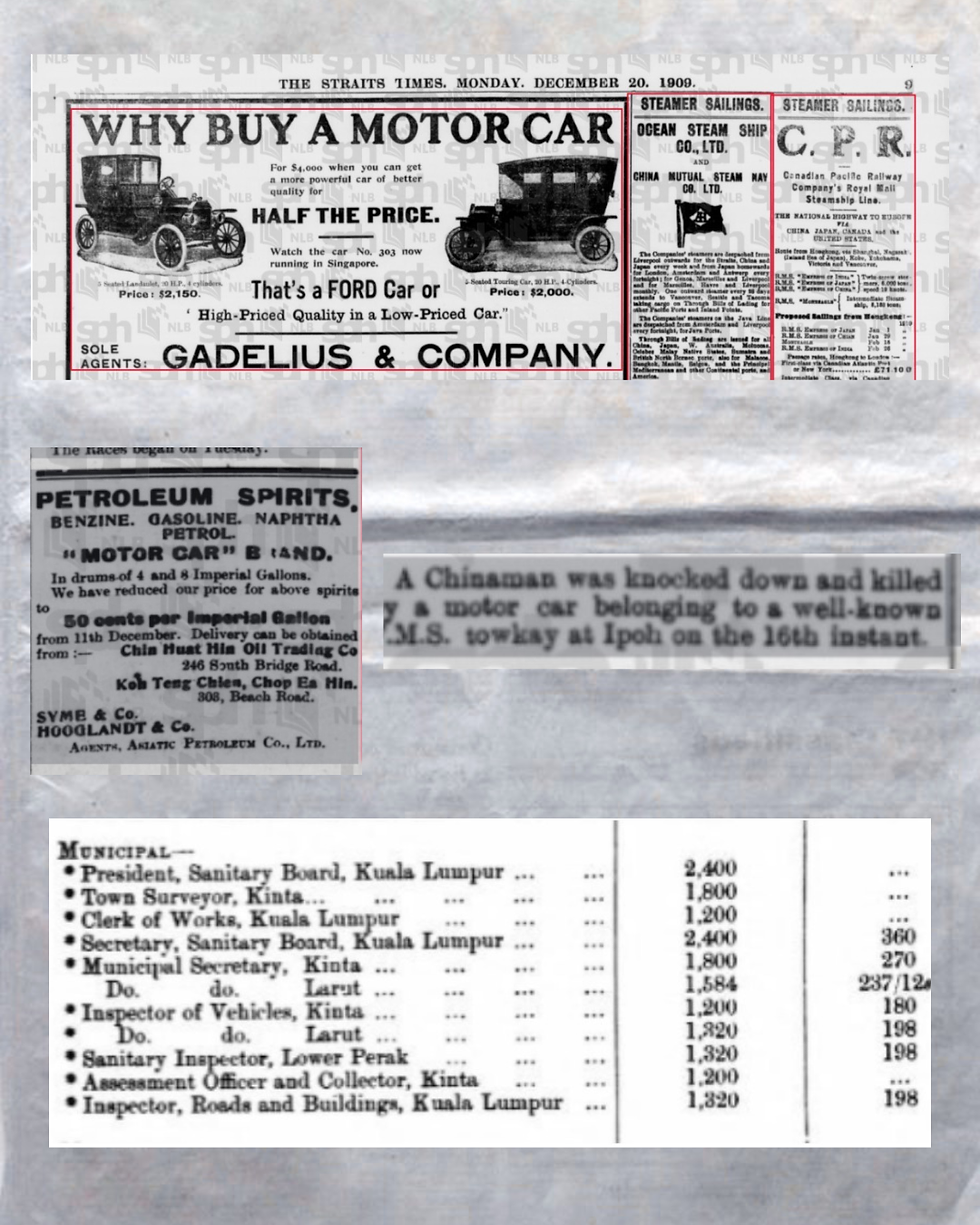
Currently, car is a necessity in Malaysian society. We use it to go everywhere from classes, cafes, shopping malls, and more. We relied on cars because it was more reliable compared to the public transportation. However, things were not the same in the past 120 years. Back then, cars were not a necessity, it was a luxury for the ultra-rich. As a 21st century person, we cannot imagine a life without those boxes with four wheels. Thus, for this article, we are going to look at the history of cars in the Malayan peninsular around the first decade of 1900. The decade when cars reached the peninsular from European and American factories. We are going to reimagine on how it feels to own a car at that time.
Origin of Cars
For those who do not know on the history of cars, it all began in Europe around 1770. According to Smithsonian.com, many Europeans attempted to create cars using steam engines. Some did work but it was too slow to be practical. It is better walking than using those boilers on wheels. However, the attempts did not end there, inventors kept improving the design using steam, petrol, and electricity. Yes, ELECTRICITY… you think electric car is a recent invention? It has been invented a hundred years ago. Despite that, the petrol cars reign supreme. By 1890s, European and American car companies such as Benz, Ford, and General Motors thrived, and demand increased for these horseless carriages from around the world.
Cars in Malayan Peninsular
The arrival of cars in Malaya is interesting. According to Yacob (2011), the presence of cars began as early as 1896. In 1903, Singapore enacted laws to regulate the use of cars and they began to issue license plates for registered cars. When it came to brands, there are multiple options to pick from British, French Peugeot, German Benz, and American Ford. However, how can we purchase it?
How to Own a Car?
To own a car, you need to buy from a merchant firm. Firms such as British Borneo Motor Company and Gadelius & Company responsible in distributing cars from manufacturers back in Europe and North America (Yacob, 2011). It is important to note that these firms worked with different companies so if you want a Ford car during this period, Gadelius dealt with them. If you desire a Chrysler or General Motors, Borneo Motors was the right dealer. After you know the dealer, you need to pick your desired car. For Ford Motors, Model N was available since 1909. It was also can be considered as cheap with the range price of $2,000. If you purchased it, you must wait for the car to arrive from their factories across the continents. Once the car arrived in Malaya, congratulations! You just owned an automobile.
Perks as Car Owners
Because of how expensive a car could be during the period, owning it projected your status as a member of the upper-class. Usually, these automobiles usually were purchased by the rich Chinese business tycoons, European officials, or the Malay royals and nobles. Owning it allows you to join prestigious clubs such as Federated Malay States Automobile Club (FMSAC) (1903-1905). Joining clubs such as FMSAC meant that you could show your cars to the public in a 15-car parade! And nothing else because the club disbanded a year later…
Challenges in Owning a Car
Price
Firstly, despite the car being around $2,000, it was still expensive for commoners at that time to purchase a car. Around 1910, the average wage for a clerk in Federated Malay States (FMS) was ranged around $1200 a year (Perak Government Gazette, 1903). If you can buy a car, then you are either part of the upper-class groups, great at saving money, or you stole it. Even then, the number of cars were limited so it was hard to steal and resell the cars without authority’s detection.
Fuel
Secondly, cars relied on petrol to move, and petrol pumps did not exist until 1921 (Shell). To solve the issue, you had to purchase a bulk of oil cans from warehouses in cities or ports like Tanjong Pagar, Singapore (Kamarudin, 2020) to supply your car. The price of each can be around 50 cents per imperial gallon or 4.55 litres (The Straits Budget, 1906). Thus, taking your car to your hometown in the rural area would take a lot of work. At least you can impress your cousins at home with all that effort.
Roads
Thirdly, the worst nightmare of a car was the limited roads. In 1911, roads around the Straits Settlements and Federated Malay States were covering 800 and 3,439 miles (1287 and 5535 km). It sounds a lot until you compare it with our roads right now that covered more than 250,000 km (JKR, 2020). North-south road did not exist until 1922, and Johor Causeway did not exist until 1923 (Yacob, 2011). It means that you could not use your car to drive from Singapore to Kedah in 1910. Fortunately for them, the early automobiles were created to endure rough and uneven terrains despite the limited roads. However, you must consider the rivers and probability of highway robberies on isolated roads before using your 2,000-dollar car.
Maintenance
Lastly, the maintenance. Usually, maintaining a car in this period was quite tiresome because its mechanism that require prior knowledge and service centre was a rare concept (Blue Ridge). To solve the issue, you need to learn the car’s mechanism yourself from the firm once you got the car. Do not worry, the firm would provide manual to guide you. If you have no desire to do it, hire someone to repair it for you. This man usually called “chauffeur”. If in some cases where your car’s parts were unavailable, you have to outsource the parts from blacksmiths or Bicycle repairmen since early cars had similarities with bicycle.
Conclusion
Owning a car in 1910 was a challenge for people back then. From non-existence of petrol stations to overpriced value, cars were not created to fulfil the needs of the commoners. It was created to entertain the rich. However, in 1920 forward, car demands increased significantly due to the economic boom of tin and rubber in Malayan peninsular. Ford Malaya later opened their assembly factory in Singapore and reduced the cost. For the rest of us, it was better to use busses, boats, or bicycles as a method of transportation as it was cheaper and reliable.
Pictures
Sources
Tate, R. (2017, December 17). The Early Days of Automobile Maintenance and
Repair. Motorcities.org.
(2025, May 19). The History of Auto Mechanics: From Early Repair Shops to Digital
Diagnostics. Blueridgeauto.co.
Gopal, Balamurugan, et al. (2020) Statistik Jalan Malaysia Edisi 2020, Kuala Lumpur, JKR
Malaysia Cawangan Senggara Fasiliti, https://crr.kkr.gov.my/system/files/202402/43%20JKR_Statistik_Jalan_Malaysia_2020.pdf. Accessed 22 May 2026.
Solomon, E. (2023, November 15). Clubbing in South East Asia. Rewind Resource Archives.
Early Cars: Fact Sheet for Kids. (2001, April). Smithsonian; Division of the History of
Technology. https://www.si.edu/spotlight/early-cars.
Yacob, S. (2011). Anglo-American Cooperation in the Malayan Automobile Market Before
the Pacific War. Jebat: Malaysian Journal of History, Politics & Strategic Studies, 38(2), 61–82. https://doi.org/ISSN%20%202180-0251.
135 years, A Timeline. (n.d.). Www.shell.com.my. Retrieved May 22, 2026, from
Rahman, N.-A., & Saparudin, K. (2021, January). Ford Motor Company of Malaya (Ford
Malaya). National Library Board.
Why Buy a Motorcar. (1909, December 20). The Strait Times, 9.
A Chinaman was knocked down by a motorcar... (1908, January 21). The Strait Times, 9.
Petroleum Spirits. (1906, May 24). The Strait Times, 1.
Supplements to the Perak Government Gazette 1903 [various Reports] including Federated
Malay States Annual Report for 1902 (p. 15). (1903). Perak Government.


Comments